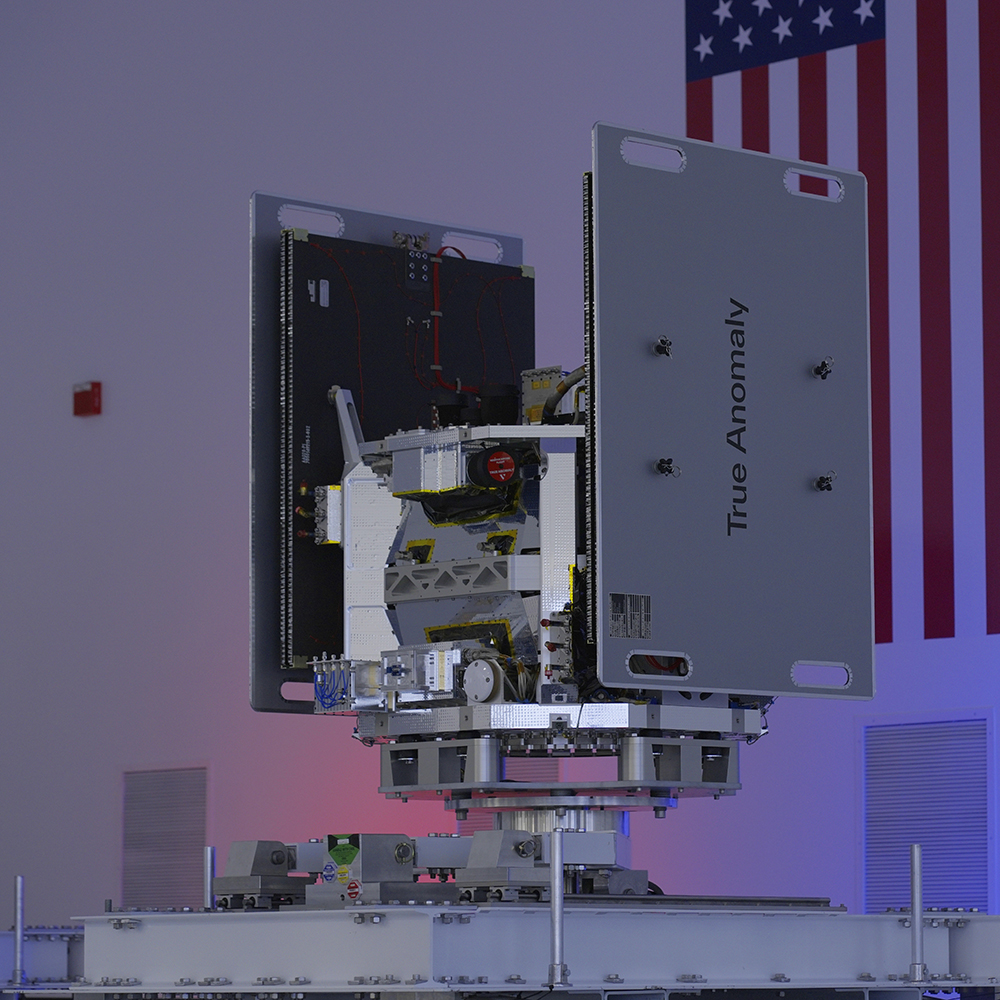

In this edition of Founders’ Corner, we spotlight Even Rogers, Co-Founder & CEO of True Anomaly. Founded in 2022, True Anomaly is a defense tech company that designs and builds advanced hardware and software systems for the U.S. to detect, track, and respond to threats in space. Its core platforms include Jackal space vehicles and Mosaic mission software, which help operators make faster, more informed decisions and take decisive action to counter space-based threats in increasingly contested environments. We spoke with Even earlier this summer, shortly after Jackal completed its most recent flight-test and live on-orbit mission, VICTUS HAZE.
When I went into the military, I became very interested in understanding the art and science of warfare. I started reading military theory and thinking about how you could decompose tactical engagements, abstract those lessons to higher-level engagements, and then use them as inputs into system design.
I helped develop that framework just as space warfare was becoming a reality. It gave me an opportunity to contribute to the doctrine and tactics of space warfare from a first-principles perspective. True Anomaly is really an extension of that work. Our goal is to become the dominant space-superiority technology provider and ensure that the United States and its allies can protect themselves in space
Jackal is our first product. It’s a space-to-space engagement platform – think of it as an MQ-9 Reaper or an F-16 for space. It’s the first purpose-built spacecraft for space superiority in the post-Soviet era, making it entirely unique in the market.
We started the development program in June 2022 with an emphasis on getting to orbit as quickly as possible. We knew it would take multiple attempts. Over the course of the program, we’ve focused on two things: rapidly maturing the product and building the infrastructure and processes inside the company to sustain new-product development.
The flight-test program to demonstrate Jackal is called Mission X. We launched Mission X-1 roughly 14 months after completing the design, which was unprecedented. The second mission followed only nine months later. Flight testing identified avionics as the weak point in the system, so we spent the next 14 months completely rearchitecting them. We launched the latest vehicle about 120 days ago, and it’s performing beautifully and is active and responsive on orbit today. Since launch, we completed spacecraft commissioning and demonstrated capabilities including uncooperative proximity operations and long-range camera tracking as part of VICTUS HAZE, the US Space Force’s end-to-end demonstration of tactically responsive space (TacRS) capabilities.
VICTUS HAZE is a dogfight in space – the first ever of its kind. Jackal and a spacecraft launched by Rocket Lab have conducted real TacRS sorties: practice missions to gain a position of advantage. Think of Top Gun. In an aerial dogfight, you’re trying to get on the six of your target. Space dogfighting isn’t as visually dramatic, but the objective is similar. You’re trying to get into the best position based on lighting angles, range, and closing velocity. Jackal is purpose-built to do just that.
What’s different about Jackal is the quality of its capability relative to its price point and the speed at which we can produce it. Existing systems can take three to four years to build and cost an order of magnitude more. At production scale, one Jackal space vehicle takes roughly four days to assemble, integrate, and test. We’re not yet at volumes where heavy robotics makes sense, so there is still a lot of hands-on labor. But production capacity scales linearly, and we’re actively optimizing it.
It’s been incredible to stand at a peak that I know is a false summit, look at the landscape, and come away from that with a profound feeling of responsibility. The folks we hire are incredible, and they’ve decided to be part of True Anomaly’s mission. They are true believers in it.
We sit at the intersection of three foundational secular trends: autonomy and AI, defense, and space, and are one of the few defense-focused companies at the center of all three.